Charge! – Activity Makeover Series

Background. I’ll share an activity. Offer some ideas on what’s wrong. Invite you to share your own diagnosis/treatment. Then (end of week) share an upgraded version of the activity. (More details about this series are available here.)

Activity and Diagnosis

A couple years ago, I sat against the wall in my sons’ bedroom, taking screenshots of my smartphone once every four minutes for an entire evening. (Why, you ask? For math!)

The result: Charge! (quite likely my only decent entry into the world of three act tasks).

About a year ago, I created an Activity Builder version of the task. And I’ve never been satisfied with it.

I think it’s better than nothing at all, but undeniably worse than the slide-driven, conversation-rich, paper-and-pencil version I posted on my blog a while back.

When it comes to the Desmos activity building code, this activity—even in its AB-powered form—succeeds on several fronts, including “create problematic activities” and “connect representations” (among others).

However, it struggles in ways that overshadow its strengths. Most notably:

#5 – Give students opportunities to be right and wrong in different, interesting ways. The AB version of Charge! feels too scripted. Too narrow. Rather uninteresting. “Do this. Now this. Next, this. Now do this.” And so on, all the way through the activity. There’s really just one path, and the activity leads students along it with minimal opportunity (or even need) for careful reflection or critical thought.

#8 – Create objects that promote mathematical conversations between teachers and students. This is a tricky one. I believe the activity could generate classroom discussion, but that the sheer number of screens works against that possibility, rather than in support of it. Let’s assume a 50-minute class period, with 45-minutes dedicated to this activity. That’s just 2.5 minutes per screen, which isn’t terribly conducive to classroom discussions. It might be wise to trim the number of screens so that there’s room for deeper discussions on a smaller set of screens.

#13 – Ask proxy questions. Would I recommend this activity? Nope. Not in its current form. I’d be much more comfortable recommending the original slide-based version. With the activity parsed into 18 step-by-step style screens, there’s no one screen with anything really interesting happening on it. One of my colleagues likes to consider the quality of an activity by asking whether any of the work students do on a given screen could be considered fridge-worthy. In other words, if they could print it out and take it home to show mom and dad, would it end up on the fridge as a proud display of something deep or delightful? Again, because I’ve chopped the interesting work in Charge! into 18 tiny bits, the answer is no. Nothing fridge-worthy in this approach.

Invitation

  • Will you offer your own diagnosis? A second opinion of sorts? What do you think is wrong with this activity?
  • Better yet, will you offer suggestions for your own treatment? How would you make this activity better?
  • Better still, will you build and share a new, better activity that addresses the shortcomings identified in one of the diagnoses?

Drop a line (or two) in the comments, or let me know what you think on Twitter (@mjfenton).

I’ll be back Friday with a new treatment of my own.

Cheers!

Parallel Lines v2 – Activity Makeover Series

(For the background on this series, go here.)

On Monday, I shared an activity addressing slopes of parallel lines. Here’s the diagnosis. Here’s the original activity.

As a quick recap, this activity does a poor job with at least two principles from the Desmos Activity Building Code:

#4 – Create problematic activities.

#5 – Give students opportunities to be right and wrong in different, interesting ways.

There were three comments on Monday’s post (which is approximately three comments more than I usually get!). Go team!

Sherrina Clark suggested inquiring about students’ prior knowledge, including a concrete context, and asking students to make (and test) a prediction about what makes a pair of lines parallel.

Sam Hoggard invited me to consider the form of the equation, and whether ax + by = c might lend itself to the kind of noticing and conjecturing I’m looking for here.

Paul Jorgens reimagined the activity as a series of “finish my parallelogram” challenges. In fact, this link could be the most valuable part of this entire post. Go check it out. Right now. Seriously. I’ll hang out right here.

Okay, you’re back? Nice. Note how Paul incorporated these principles:

  • Incorporate a variety of verbs and nouns. (Sketch, explain, convince, write equations, notice, imagine, etc.)
  • Ask for informal analysis before formal analysis. (He asks for a sketch on Screen 1 with no grid, then adds some structure and asks for another sketch on Screen 2.)
  • Give students opportunities to be right and wrong in different, interesting ways. (I am in love with Screen 8. Holy cow.)

Paul also identifies some areas for improvement, and mentions that this is a work in progress. But there’s a lot to love already.

And while I think there’s still room to grow in problematizing this task, it’s a big step up from my original activity.

My Upgrade

The best laid plans, etc. My original intention was to design and build a new version of this activity. I made it through the design stage, but only part way through building. Here goes:

Screen 1. Show students a graph of two lines. Ask them to adjust one line (using a movable point) so the lines are parallel. Then click “test it!” If the lines are parallel, they’ll never intersect, right? So I’ll find out where the lines do intersect, and zoom the window to show that point. “Bummer! Your lines intersect 103 units away from the origin,” or something like that.

nov-10-2016-17-18-34

Screen 2. “Try again. Adjust your line. Really focus this time!” 🙂

Screen 3. “This is rough, right! Try just one more time.”

Screen 4. At this point, offer a lifeline. Give the same challenge, but display the equations of the lines as students tinker. My hope/anticipation here is that they’ll notice, “Hey, my lines are pretty close to parallel right now, and the equations have almost the same coefficient for x. Let’s see if I can make those coefficients exactly the same to get the lines exactly parallel!” Maybe a little optimistic? We’ll see. For what it’s worth, this would be a pretty important discussion-facilitation screen.

Screen 5. Graph screen with a multiple choice question: “Which equation has a graph PARALLEL to the line shown here?” Four options, followed by “Explain your answer.”

Screen 6. Graph screen with a math input question: “Write an equation for a line PARALLEL to such-and-such equation.” When students hit “submit,” the line appears on the graph. Feedback, but with a bit of a delay to allow room for thinking.

Screens 7-8. Same game, but with perpendicular lines. The animation would involve rotating lines, instead of zooming to the point of intersection.

nov-10-2016-17-47-39

Screen 9. Similar to Screen 4. Students manipulate the line, but also see the equation. (I’m still thinking through this part, to be honest.)

Screens 10-11. Multiple choice (similar to Screen 5) followed by write your own equation (similar to Screen 6).

Screen 12. Time for a card sort.

screenshot-2016-11-10-17-43-26

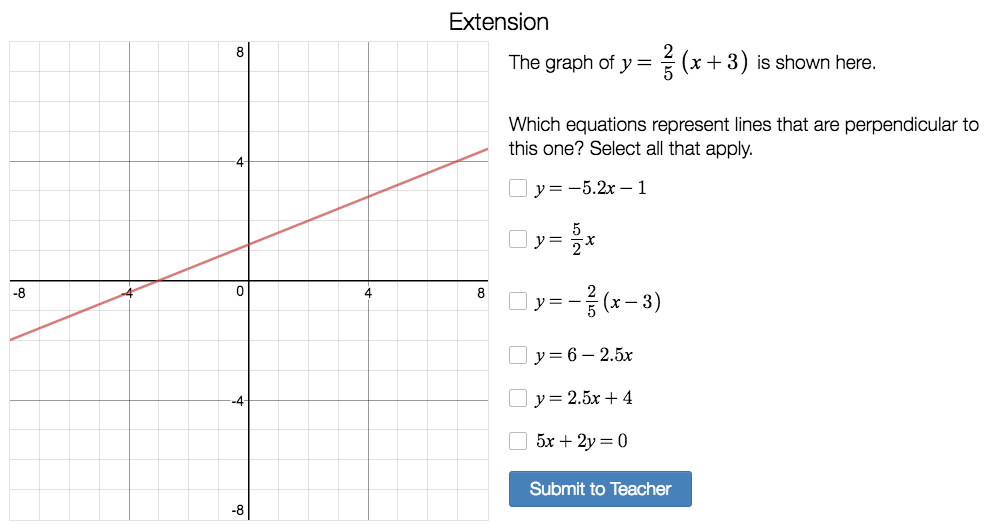
Screen 13. I’m not sure if this is an “extension,” or just a good exit ticket style question. It goes above and beyond the activity by introducing equations in various forms, so it fits the “extension” mold in my mind.

screenshot-2016-11-10-17-51-02

My Analysis

Principle #4 (create problematic activities): Improved. The challenge is clear from the word go: make these two lines parallel (and later, perpendicular). Is that scenario contrived? Absolutely! Did I try this with some folks after lunch today and see it quickly move into a contest of who could make their intersection point farthest from the origin? Absolutely again!

Principle #5 (give students opportunities to be right and wrong in different, interesting ways): Improved. Not perfect, by any means. But better. It’s less step-by-step, everyone do the exact same thing, and a little more free-form exploration.

Your Thoughts?

What do you like here? Where does it fall short? How could I further improve the ideas I’m exploring (or is this one destined for the trash heap)?

Let me know in the comments, or drop me a line on Twitter.

Cheers!

P.S. If you read to the end of this one, you’re a champ! Well done. 🙂