[One-Minute Makeover] Algebra 1 • Topic 1 Assessment (The Sequel!)

Welcome Back!

Two posts and this is officially a series, right? Off we go!

Algebra 1 Assessment, Before

Let’s spend a little more time (how about 60 seconds?) looking at the second half of that old, filthy Topic 1 assessment:

Screen Shot 2014-01-18 at 12.01.41 AM

That’s it. One measly simplification question. Nothing inherently wrong about the question itself, but…

Algebra 1 Assessment, After

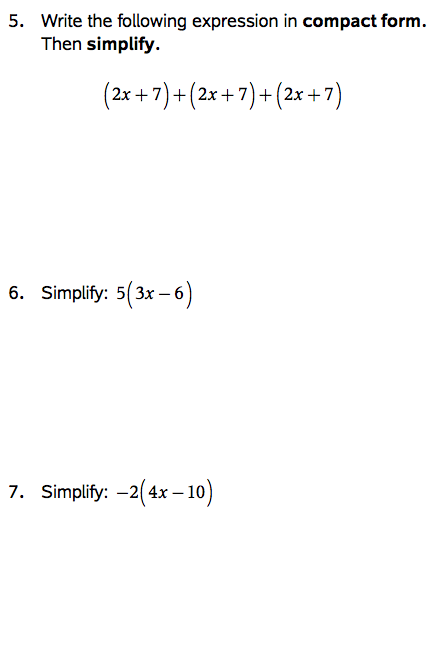
With the updated Topic 1 assessment, I wanted to address to potential weaknesses to the approach I took on the original. First, I felt like one question wasn’t enough to get a sense of student mastery of distribution. For students who have mastered this, each question takes between 5 and 20 seconds, so time wasn’t an issue. With that in mind, I added two more “standard” distribution questions and scaled their difficulty:
Screen Shot 2014-01-18 at 12.04.29 AM

(If the “compact form” comment doesn’t make sense and you wish it did—rare combination, possibly—let me know in the comments.)

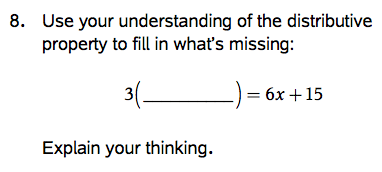
Next, I wanted to add a question that required students to think outside the box, even if just a little, and at the same time would provide them with an opportunity to explain their thinking. It’s not terribly profound, but since we didn’t even hint at factoring during the lessons leading up to this assessment, I think this rather bland factoring problem, when appearing in this context, actually demands some critical thinking on the students’ part. Enough yammering, here’s the question:
Screen Shot 2014-01-18 at 12.07.21 AMWrap Up

Thoughts? Comments? Questions? Outrage? Share any and all in the comments!

(Bonus Material: Confession)

The “original” revamped version of the Topic 1 assessment only included 7 questions. I added #8 just to spice up the blog post.  Actually, in thinking about writing the post, I had an idea for how to—potentially—make this assessment even less terrible for next year. So it’s sort of a lie, and sort of not, with an emphasis on the latter, at least in/from the future. Errrr… Time travel. Brain hurts. 12:12 am. Time for bed.

[One-Minute Makeover] Algebra 1 • Topic 1 Assessment

Welcome to the Makeover!

Here’s an idea: I’ll write a post. It will take me a few minutes, or more.

Next, you’ll read the post. It’ll only take you a minute. It’ll be about assessment. Specifically, me describing how I took a terrible assessment question and made it less terrible.

Ready? Here we go!

Algebra 1 Assessment, Before

In my previous post I linked to the Algebra 1 SBG assessments I wrote in 2011-2012. Largely, they stink. Here’s an example of a terrible question from the Topic 1 assessment (full list-o-topics is here):

Screen Shot 2014-01-17 at 11.17.29 PM

That was Form A, and I’ve created about a million forms (okay, more like 5-10 forms) for each assessment (in every class, though, so the total really is pretty close to a million). Here’s a similar question from Form B:

Screen Shot 2014-01-17 at 11.22.17 PM

I was trying to write questions that assess whether my students understand the commutative, associative, and distributive properties. In particular, I wanted to see if they could name the properties based on an algebraic or numerical example. I was also hopeful that they knew which operations are commutative and associative (and which are not).

Oh. My.

Well, what I ended up with in my first attempt were some miserable true/false questions that don’t really accomplish any of what I was hoping for. An especially unfortunate consequence of the way I wrote the questions was that students who might otherwise have explained their reasoning quickly learned that this problem demanded no such thing. A one-word answer for each part is all that was called for. Worse yet, because I failed to require any record of thinking on the page, the majority of my students resolved to do no thinking at all in their minds. It became a guessing game, and one that they’re not particularly skilled at.

Algebra 1 Assessment, After

This year I’ve set about rewriting my Algebra 1 assessments. They’re not perfect, and I’ll probably want to run them through a revision cycle again next year (and the year after, and so on forever), but there are a few questions here and there that strike me as significant improvements over their original counterparts.

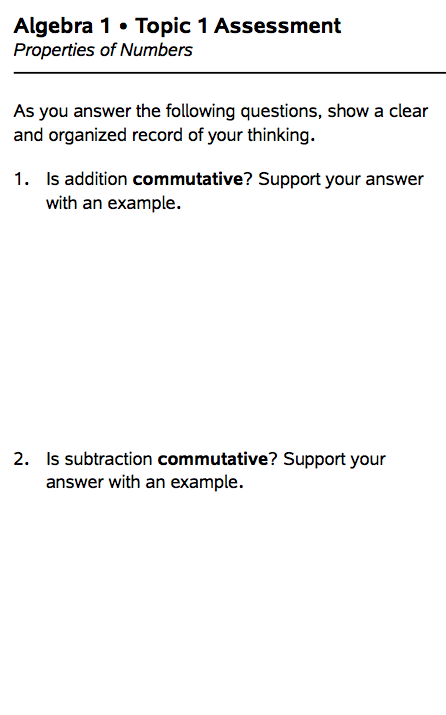
Here’s what the corresponding question looks like on the current Topic 1 assessment:

Screen Shot 2014-01-17 at 11.32.14 PM

Just below #2 I ask whether multiplication is associative (#3) and whether division is associative (#4). It’s immediately more demanding, doesn’t let students off the hook, doesn’t tempt them to do less thinking than they might naturally do, and gives me a fairly clear sense of whether students know which property is which, and which operations are commutative/associative.

In writing this up, the only immediate change that I’d like to make to the question is to throw a third sentence in between the two already there. “Explain.” It’s implied, but it would be nice to state it explicitly. So then I would have something like, “Is addition commutative? Explain. Support your answer/explanation with an example.”

Wrap Up

So, was that terribly longer than a minute? Or was it simply a terrible minute? Let me know what you think about this feature in general and/or this question comparison in particular in the comments.

Cheers!

Assessment Update: SBG in Algebra 1

With the start of a new semester, several of the assessment ideas that have been floating around in my brain are making their way into my classroom. I thought I might break my recent and unintended blogging silence (eleven weeks!) by sharing some of what I’m thinking, some of what I’ve done, and some of what I hope to do. Here goes…

The Beginning: Algebra 1

In August 2011, inspired by this post from Dan Meyer, I introduced SBG into my Algebra 1 class. There were some bumps along the way, but overall I was thrilled with the change. I loved being able to answer student and parent questions along the lines of, “What can Johnny do to improve his grade,” with specific comments about strengths, weaknesses, and areas to attack. (Of course, the improve-your-grade-by-improving-your-understanding-and-then-demonstrating-this-improved-understanding is already a huge upgrade over the days of old when kids—and sometimes parents—would ask/beg for extra credit. But I digress…)

I’m somewhat embarrassed of the quality of the assessments I wrote then, but it was a start. For anyone brave enough to look at that first wave of SBG assessments I wrote, enter at your own risk. (BTW, I’ve abandoned my favorite app in the history of the world—Dropbox—for the new kid on the block—Copy—because of the oodles and oodles of free space, and the seemingly comparable features to Dropbox. After a few referrals I’m at 80GB of free storage. If you’re interested in signing up—15GB + 5GB for using the referral link—go here.)

This year I’ve decided that my assessments need a major improvement in quality, so I’ve set about to accomplish as much of that as I’m capable of (while still creating resources and preparing for all of my other classes). The I’m-totally-not-finished-yet-but-have-a-look-if-you-want second wave of Algebra 1 SBG assessments live here.

I’ll continue writing new assessments for those 24 topics—the same topics I sketched out in August 2011—through the rest of this semester. Originally I just had a list of topics; since then I’ve added “I can…” statements to the course outline. However, I’ll scrap both of those in the next year or two (even with the “new-and-improved” assessments I’m writing this year) as we transition to an integrated Common Core sequence. I expect some of the topics, lessons, and assessments will slide into our new Grade 8 course, while others will make their way into the high school’s Math 1 course. Nevertheless, one major and lasting benefit I’ll carry forward from this Algebra 1 SBG experience is (I hope) a better understanding of how to write decent assessments. At the very least, I’m learning to identify what I don’t like about many of the assessments I’ve written.

Next Up

That’s all for now. I’ll write again soon about “Phase 1.5,” my experience applying SBG to AP Calculus AB midway through the 2012-2013 school year.

Quadratics Matching Activity, Take 2

Visitors and Commenters? Woohoo!

I’m amazed anyone reads this blog, and even more blown away that people have posted so many thoughtful comments. Shortly after my long-winded sky-is-falling post, I added a quick note about launching an activity with as few words as possible. There were a few great comments on this shorter post about how to improve one particular activity (matching equations, intercepts, and graphs of quadratics).

The comments that caught my eye include:

Could you build on the task with an addition to the end where they create their own quadratic and then write up a key for the graph, intercepts and factors? They could switch it with another group and verify their answers? – Dan Anderson

One thing I’ve done occasionally with matching activities is deliberately leave one out. So they end up with an equation that has no graph, or vice versa, and have to generate the missing one. For added chaos, leave out one of each – just let them know that this was done… – Gregory Taylor

Love this activity! I think the concise written directions are a good idea, too. On my first day of Algebra 2 class, I had a similar but less pretty handout where each quadratic has a graph, an equation (in some form or other), a table of values, and a word problem. Each kid as they walk in the door gets one, and they need to find the others who have the same quadratic in order to form their groups of 4. – Joshua Zucker

Activity Revamp

So tonight, while standing guard next to the boys’ bedroom door (they have a tendency to leave their beds when they should be drifting off to dreamland; my wife calls it whack-a-mole, probably because of this)… Where was I? Oh yeah, standing guard…

So while I was standing sitting guard next to the boys’ door I revamped my rather unassuming matching quadratics activity to include some of the suggestions above. (Disclaimer: My activity doesn’t include Joshua’s table of values or word problems, but I think those are awesome ideas, and will probably find a way to include them in another activity, either for linear or quadratic functions.)

For reference, the old activity handout is here. And for what it’s worth, the new one is here. My game plan is to start with an entire-class matching activity and follow it up (either on the same day, or on another day for review/additional practice/to beat a dead horse) with a small group activity (groups of two or three students, matching at their tables). For my students who don’t hate school and who think meaningless competitions of an academic nature are enjoyable (read: third period, not fifth period) we might play three quick rounds of “fast as you can” matching. Fist bumps to the fastest group in each round, and fame and glory for the fastest time of the day.

I think the new wrinkles make it a much better activity. We’ll see what my students think/how they respond. If you use it with yours, let me know how it goes.

P.S. The handout no longer includes directions, as I’ve included those on a slide that can be displayed for the entire activity. (Once we start cutting up the old handouts, the directions made their way to the blue bin by the door pretty quickly.)