Entering the Discussion
Two Thursdays ago I jumped in the middle of an ongoing discussion about assessment by posting this. It was essentially a call to arms, a request to join forces in strengthening the quality of our assessments.
Then, just after midnight on Saturday morning Daniel Schneider blew my mind by posting this. If you haven’t read it yet, stop messing around on my blog and get yourself over to his. Make sure you follow all of the rabbit-holes provided in the links. (He wasn’t kidding when he said he was a master aggregator.)
(Update: While I was fiddling with this draft, Daniel threw this down as well. Go ahead and put another educator on the list of people I want to be like when I grow up.)
What’s Next
So where do we go from here? What should we do with all of the interest and enthusiasm surrounding assessment? I see one thing as a no-brainer:
Let’s create a centralized location with links out to quality posts and articles about creating excellent mathematics assessments.
I’m hopeful that a certain master aggregator will lend a hand here. (Update: He will!) Over time we can add more links to resources and even invite members of the so-called better assessments movement to write articles addressing specific topics of need.
Archive or Conversation?
Beyond that, I see two lines of attack: (1) Build an archive; (2) Foster a conversation.
Let me explain.
It would be incredibly valuable to have access to a well-populated, easily-searchable database full of rich assessment questions.
It would be even more valuable—incomparably so—if we learned, as an entire community, to write such rich questions.
In the first case (the archive-building scenario) the focus is more on writing and/or gathering good questions and assessments, and then serving them up in a helpful way. A noble task, to be sure. One I hope others will take up and carry to great heights. (By the way, if that’s you, check out OpusMath, follow them on Twitter, and start uploading like crazy.)
But more than a comprehensive archive of excellent problems with a slick user interface, I think our most essential need right now is to develop an army of amazing assessment authors.
If you agree that the ongoing, teacher-developing conversation is at least as important as the creation of a fantastic archive, then I invite you to join me in the following challenge.
Write An Assessment You’re Proud Of
In a recent email exchange with Daniel, I shared a massive vision I have for creating this group of great assessment writers. He suggested starting with something smaller (something vital, yet attainable) and building from there.
With that in mind, here is my/his/our challenge to ourselves and to you:
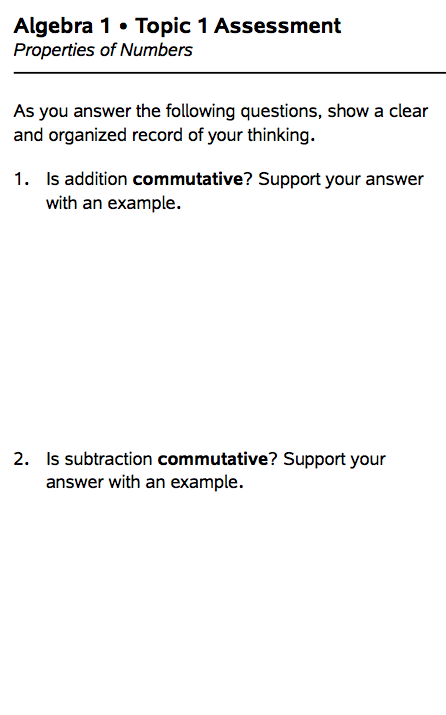
I want to challenge the blogotwittersphere to write an assessment they’re proud of. To pick a skill/concept/objective and write a targeted assessment that measures this objective at various depths. Or, if they already have an assessment they’re proud of, to share why they’re proud of it—what is it about this question/this series of questions that makes this assessment meaningful? That finds a way to assess both procedural and conceptual understanding. That gives students an opportunity to exceed expectations. That has an ‘explain’/’justify’ component. I don’t know if these things are possible for all skills and objectives, but this is why I want others to be thinking about it too.
The end goal is: create an assessment you’re proud of in terms of format or questions or depth or all of the above, and explain why you think this is something worthwhile.
(I tried to recast his challenge in my own words, and realized I was better off stealing the thing wholesale, with his permission, of course.)
Where Do I Sign Up?
If you’re interested in playing along at home, start with a one-minute survey. Then hop on the Twitter and spread the word! The more voices we have in the conversation, the better we’re all going to get.
What You Can Expect From Me
Once this blog post goes live, I’ll do the following:
- Set up betterassessments.wordpress.com (the “home” for the better assessments conversation)
- Gather already-existing resources together in an Assessment Authoring Boot Camp section of the blog (Daniel Schneider has agreed to lend a hand; additional volunteers welcome)
- Put out an official “call for assessments” over a two week (?) period in the near future, including submission guidelines
- Feature a small number (one to three?) of these assessments each week as guest posts on the blog (including the “explain…” bit from Daniel’s challenge), and invite the “better assessments” community to offer feedback, constructive criticism, etc.
As with any group project (and I hope this turns into a massive group project), better ideas will come as soon as brains other than my own start their wheels-a-turnin’. I’m not married to any of the details sketched out above, so long as we find a way to establish an ongoing and positive conversation about assessment.
The Dailyness is the Key
I feel I should explain the last bullet under “What You Can Expect From Me.”
Let’s dream big. Imagine that 100 math and science teachers from all sorts of different grade levels and courses submit assessments when the call goes out. The assessments range from decent to amazing, and we’re all stoked because 100 people (100 people!) played along with this little experiment and we have heaps of assessments to look at and learn from.
If we’re not careful, we’ll squander most of the opportunity for conversation presented by 100 such submissions. My intention is to highlight a few assessments at a time so that busy teachers (that’s us!) have an opportunity to dig into each assessment in depth, over the course of an extended period of time. (Whether or not my suggested approach will achieve the goal is open to discussion.)
I think we’ll experience the most growth as a community if we employ a slow-and-steady approach, rather than go after this all at once. It’s the reason many of us find blogs and Twitter more powerful tools for sustained professional growth than fantastic-but-isolated conference experiences once every year or two. The dailyness of our practice is the key to our growth.
What To Do With a Head of Steam
If this project isn’t dead in a few months, then I’ll share some details of the bigger vision I have for this assessment conversation. It has to do with recruiting and organizing people at various levels and in various subjects into assessment-writing cohorts. They’re exciting plans (at least to me), but possibly unrealistic. In the coming weeks I’ll invite some of you to tell me what has potential, what’s a waste of time, and what needs tweaking to become realistic.
Some Closing Thoughts
I think multiple-choice questions are generally inferior to free-response questions. I also think that both styles of “one-off” question are completely inferior to well-crafted performance assessments. However, I also believe that poorly-written MC and FR questions are inferior to well-written MC and FR questions. With that in mind, I think it’s entirely appropriate to allow MC and FR questions into the discussion at betterassessments.wordpress.com.
With that said, I think the MC/FR/Performance Assessment classification of assessment questions isn’t as helpful as the conceptual/procedural/synthesis approach described by Daniel here and here. I certainly like this latter three-part structure better than then conceptual/procedural/application framework I’d been mulling over prior to reading all these great blog posts on assessment.
Comment Time
Heart beating with uncontrollable excitement? Bored out of your mind and wondering how you made it to the end of another lackluster post? Have a suggestion? A critique? An idea? Drop a line in the comments and keep the conversation rolling.