Where’s the emphasis? Right where it belongs.

One of the things I love about Desmos is that it allows students and teachers to keep the focus where it should be. Working on a linear approximation problem in Calculus? It’s easy to get caught up in algebraic and numerical details and lose sight of the big (somewhat amazing) picture: We can approximate a crazy curve with a simple line! (Provided we stay in the neighborhood, of course.)

And if you make a mistake, it can be an absolute bear to track it down. Is your issue differentiation? Evaluating a function? Or is your weak spot related to what’s happening visually in linear approximation?

Here’s a problem from last year’s AP Calculus review workbook:

image

There’s a lot of great work on the page.

  • Take the derivative? Check.
  • Find the slope of the tangent line? Check?
  • Find the equation of the tangent line? Check.

But that’s where things fall apart.

Now, imagine you’re a calculus student. You’ve been hammering away at this thing for several minutes. Maybe you don’t even remember what the problem’s asking for in the first place. You get to this point, you scan the original problem, see an input value of 4.2, and presto-whammo, plug it in and out comes 0.4. “Great news, everyone! That’s on the list! Well done, folks. On to the next problem!”

Only, that answer is entirely wrong. So how do you debrief this problem with a student, small group, or class, so they can see the source of the error? For problems with even a sliver of something graphical, Desmos has become my go-to tool for helping students find and fix their errors.

Here’s what I built with a pair of students last year (with a link to the live graph here):

Screen Shot 2014-11-12 at 6.43.51 PM

Students can’t use Desmos on the AP exam (for now, anyway), so I’m not trying to permanently sidestep what they ultimately must be able to do sans technology (or with a device from that “other” graphing calculator company). But what we can do in class with Desmos is build a better visual/conceptual sense of what’s happening in this problem so they’ll be more prepared for something similar in the future.

Here’s a short list of what this Desmos graph did for us in this scenario:

  1. We offloaded the algebraic and numerical work of finding the derivative (and evaluating it for a particular x-value) and built the tangent line in a matter of seconds (rather than minutes). Mentally, we’re still fresh, and ready to focus on what the problem is really asking us to do: compare the function and the tangent line.
  2. We gave things specific names so we could call on them in our time of need. Okay, that may sound a little dramatic. But think about why we even bother with function notation. Why give a function a name? Well, why did your parents give you a name? So they could call on you! (“Alfred! Get down here and pick up your comic books!”) So then, why do we give functions names? Because function notation is on the Chapter 8 test in Algebra 2? No! We give functions names so we can call on them. So they can do our bidding. If you don’t name it, it’s difficult to put a function to work for you. Give it a name? Now our wish is its command. (It sounds a little bit like we’re going to take over the world, with math as our trusty sidekick.)
  3. We gave things specific names so we could keep clear in our own minds the various moving pieces in the problem. There’s a function. We called that f. There’s a tangent line. We called that l (or t, or whatever). As we approach the end of the problem, and we start looking for the error, it’s easier to avoid simply evaluating f(4.2) or l(4.2), because we know we’re dealing with both f and and l. (How could we forget?! We named them! We practically gave birth to them.)
  4. We visualized the error with a beautiful little orange bar, and in doing so imprinted on our minds (for future problems) what linear approximation error looks like.
  5. We dropped a slider in so we could answer a hundred related problems in a matter of seconds, further clarifying for the confused student (or teacher; I was terrified of linear approximation my first two years of teaching Calculus) what the problem is really about, and all with a nifty, dynamic burst of compare-and-contrast.

Do you need Desmos to teach this stuff? Maybe not. But given the option, I’ll use it every time. Last year in my classroom, we got a lot more out of a five minute Desmos-supported conversation than we did in a whole day of business-as-usual notes and examples.

So this year? We went straight to Desmos and put the emphasis right where it belongs.

P.S. I love GIFs.

Screen Recording 2014-11-12 at 07.12 PM

Try, Try Again

Monday wasn’t the greatest of teaching days. But in teaching we have a thousand opportunities to try again. If at first you don’t succeed… Write a long blog post reflecting on what went wrong, and then go back to the drawing board.

Tomorrow’s Game Plan

When I taught this lesson three years ago, it lasted 40:01. I’m not kidding. (By the way, that link is a whole other coming-over-from-the-dark-side post that I don’t have time for right now…) Two years ago and last year? Basically the exact same lesson. Six problems. Work through ’em as a class. Everyone stick together. Eyes on me. And so on. Bell rings. Head home. Practice. Try not to cry.

A quick preview:

image.001


And if you’re curious, a closer look, compliments of your friend the PDF.

If you read last night’s post, possibly the only thing that I made clear was my desire to shift away from “all eyes on me” instruction where it makes sense. (Which, as it happens, is in quite a few places.) With that in mind, here’s my plan for tomorrow:

  1. Use Desmos, Keynote, and MathType to build a set of cards containing: graphs (12), integral expressions (12), and directions (1)
  2. Print, slice, and drop in Ziploc sandwich bags. (Hooray for Costco!)
  3. Distribute one bag to each group (~4 students).
  4. Give them about 5 minutes to sort. Then 3 minutes to describe in writing their thinking. (“How’d you match each graph with its integral expression?”) Then 2 minutes to debrief as a class.

Now, what to do with that extra half hour…? I’m still working on that bit. In the meantime, I’ll share some of the cards. Enjoy!

AB Day 58 Sorting Activity.001

AB Day 58 Sorting Activity.002

AB Day 58 Sorting Activity.014

AB Day 58 Sorting Activity.020

Wish Me Luck!

I’ll check back in tomorrow with a brief report on whether tomorrow is a success, or another borderline failure.

The Goods

All of the resources I created are available here.

CMC South 2014 Recap: The Sessions

Last weekend turned out to be one of my favorite weekends of my teaching career. I haven’t exactly been at this for decades, but 11 years is no short span either. The weekend was that enjoyable, at least for me. If I’m going to do any justice to the recap, I’ll need to split it into two parts. So much of what was wonderful about last weekend was the sessions, and so much of what was wonderful about last weekend had nothing to do with the sessions. I suppose that means I have the breakdown for my recap:

Part 1: The Sessions

Part 2: Everything Else

Onward to the sessions-focused recap!

Session 1

La Cucina Matematica: Free Tools for your Math Kitchen
(Matt Vaudrey, John Stevens • Friday, 8:30 am)

After cramming down some continental breakfast (thanks, Comfort Inn!) and making the trek from our hotel to the Hard Rock Hotel’s basement, I sat down for a mathematical treat: John Stevens and Matt Vaudrey’s 90-minute version of La Cucina Matematica. They battled through some technical difficulties at the start and soon found their rhythm, taking turns running the show, moving the participants through a series of mathematical appetizers, entrees, sides, and desserts. If you don’t follow their blogs (here and here) you’re missing out.

My highlight from John’s segments was seeing how he facilitated a couple of Would You Rather Math discussions. I’ve been a fan of these since last winter (even contributing a prompt or two myself), but it was a delight to see John in action, leading teachers through a couple of mini-discussions, regularly zooming out to discuss the moves he was making and the opportunities inherent in the format so we might take these tools back into our own classrooms.

My highlight from Matt’s segments? Easy: Mullets. But maybe not in the sense that you’re thinking. I was already familiar with his mullet ratio work (as well as its popularity with teachers and students), so the highlight for me didn’t occur until about 20 minutes into the mullet conversation. It was then, near the end of this segment, that I realized how much work Matt has put into weaving this ridiculously-engaging context into a rich sequence of mathematical topics. I used to think of the mullet ratio lesson as a great one or two day task. Now it looks more like a swiss army knife scenario, useful in developing maybe a dozen key ideas in middle school mathematics. Well done.

Session 2

Reasoning, Discovering, and Critiquing with Networked Tasks
(Eli Luberoff • Friday, 10:00 am)

Eli Luberoff is a legend. (He’s like the Madison Bumgarner of ed tech startups. Minus the snot rockets. I think.) And Desmos is simply a math teacher’s dream. 90 minutes sitting in a room listening to Eli talk about Desmos turns out to be pretty fantastic as well. Highlights from the session? Three come to mind:

  • Regressions. Yep, it’s live. In fact, Eli and Team Desmos launched it around 4 pm the day before the conference began. Someone give that man a raise!
  • Desmos Activities. I’ve tinkered with all of these in the past, including briefly highlighting them in various workshops and conference sessions, but I’ve only tried one with my own students. Seeing a whole “class” in action at once was magical, and inspired me to bring more of these into my classroom in the near future.
  • Because I had been tinkering with the regressions preview throughout the week as I prepped for my own CMC South sessions (one of which featured Desmos), Eli dropped my name during his session. Something along the lines of, “He’s on there practically 24 hours a day!” All I could think was, “He said my name! He said my name! Okay, breathe… Calm down… But he said my name!”

Sessions 3-5

Desmos: Infinite Graphing Power on Every Device
(Me • Friday, 1:30 pm)

Turning Students Into Posers + Solvers
(Me • Friday, 3:30 pm)

Desmos: Infinite Graphing Power on Every Device
(Me • Saturday, 8:30 am)

I was pretty excited for these sessions, my first conference presentations since joining the MTBoS. I plan on writing more detailed recaps in the near future. For now I’ll just say that I had a blast, and feedback was super positive.

Session 6

Offering a Thought-Provoking Experience Through Math
(Edward Burger • Saturday, 10:30 am)

I packed up from my last session, still riding high after showing off Desmos to a small-but-packed-room of teachers. I wasn’t quite sure what to attend next (I confess to not doing much homework in regards to which sessions to attend, as most of my time was spent in last-minute slide deck prep). After narrowing it down to two options, I saw Fawn Nguyen on her way to one of my two choices: Edward Burger’s session on “Offering a Thought-Provoking Experience Through Math.” I may have been one of only a few people in the room who hadn’t heard of Dr. Burger before, but after about 15 minutes I realized I was in for a treat. I gave the whole live-tweeting a session thing a try, so rather than recount the highlights anew, I’ll just drop a few of my favorite quotations:

One from Matt Vaudrey:

And the clear fan favorite, based on the fact that this received more retweets and favorites than anything I’ve ever posted before:

Session 7

Transformulas: Simplifying Relationships with Hi & Lo Tech
(Jedediah Butler • Saturday, 1:15 pm)

I met Jedediah Butler for the first time in Vaudrey and Stevens’ La Cucina session the day before. He was tinkering with something in Desmos, and I was blown away. (And a little nervous, since I was supposed to be wowing people with my Desmos chops later that day.) When I heard that Jed was giving a session on Geogebra—one of my confessed math/tech weak spots, despite my interest and affection—I knew I couldn’t skip it.

Jed didn’t disappoint. In fact, I was even more impressed with the sheer quantity (and the consistently excellent quality) of the Geogebra applets he’s created. It’s really a remarkable collection. Go check it out. Plus, it was loads of fun to sit in on a session of a MTBoS colleague who made the jump from “semi-make-believe Internet friend” to “hey, we’ve actually met in the flesh friend” just 24 hours earlier.

Session 8

Teaching Math Using Real-World Topics
(Karim Ani • Saturday, 3:15 pm)

What’s the best way to wrap up an amazing conference? With an amazing last session. And Karim Ani (founder of Mathalicious) certainly didn’t disappoint (even with all the hype being pumped out by the Mathalicious Twitter account). I was blown away by the presentation as a whole, and in particular:

The thought I couldn’t shake toward the end of the session, and one that captures what I believe to be the strongest feature of not only Karim’s session but also the lessons Mathalicious keeps churning out, is that a day (or better yet, a week) as a fly on the wall in the Mathalicious offices could literally change a math teacher’s life. If there’s ever a summer internship program, I’ll be the first one to camp out on the office doorstep in the hopes that they’ll let one more aspiring mathematical conversation-starter in the room. After listening to Karim for 90 minutes, I was hungry for more. And not only for well-designed lessons with slick visuals and applets and thoughtfully-crafted teacher and student resources… It’s the whole Mathalicious way of thinking through lesson design and student engagement that has me most excited. I hope to stoke that excitement spark into a full-fledged flame in the near future.

Desmos and the Diagonal

This morning I ran across an entertaining tweet from someone with a sweet first name:

I was reminded of Dan Meyer’s treatment of this problem, and began wondering about adding shading to Mike’s work in Desmos. In between meetings today at school I tinkered a bit, and discovered a totally-inefficient, but still-effective way of getting it done.

Here’s a glimpse of what I ended up with…

…and a link to my graph in Desmos.

Show Off

Of course, @Desmos went about it in a much more intelligent way… But I’d venture that I derived more joy from finishing my long way round.

P.S. This is my first blog post since June 5. I hope to sit down soon to write about the reasons for my time away. Needless to say, the gap between posts has been far too long. But life and work have their demands, and sleep is nice at times, too.

Desmos: Dot Capture Game

I created a silly little game for my Algebra 1 students several weeks ago. The motivation? Five-fold!

  • We’re a little weak with graphing lines. Some open-ended, Desmos-driven, instant-feedback style practice may help.
  • Domain and range? Yeah, not so much.
  • Inequalities? Haven’t done them justice. Yet. (Growth mindset, baby!)
  • Vertex form for quadratics? Still struggling.
  • We tried Des-man a few days before this game and found nothing but pain and frustration. Some could be attributed to me (in particular, a bungled launch of the activity), some to students’ lingering struggles (noted above), and most of the rest to the declining state of our netbook cart. (But they seemed so cool in 2009!)

At any rate, to get that bad taste out of my mouth and set the stage for greater success on the next Des-man go around, I created the Dot Capture Game. Here’s what you need:

  • Students (working in pairs)
  • Devices (we actually used 50% smartphones, 25% tablets, 25% laptops)
  • The world’s greatest, most beautiful graphing calculator

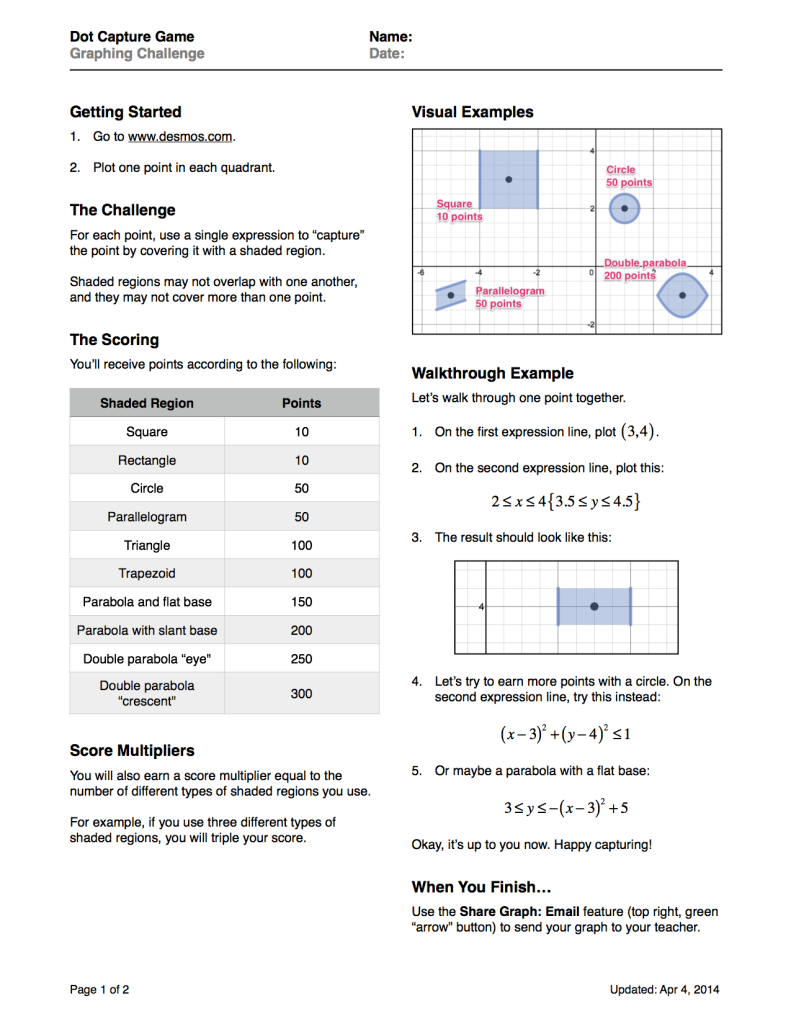
And of course, the handout:

Dot Capture Game


Getting Started

Give a brief intro—or none at all—and turn ’em loose. If your experience is anything like mine, you’ll find yourself the weaving in and out of some great (albeit trivially-inspired) conversations about slope, intercepts, point-slope form, domain, range, inequalities and shading, vertices, direction of opening, etc.

This is definitely not high-quality modeling stuff (it’s not even low-quality modeling stuff), but it proved a great way to engage students with meaningful (read: productive) practice on a variety of topics related to graphing.

Oh, and the winner in my class? Here you go:

winner


Final Thoughts

After trying this out in Algebra 1, I thought I’d throw it at my Algebra 2 and Precalculus students to see what they would do with it. It turned out to be good practice in those settings as well. Before sharing with these followup classes, a quick tweak to the handout was in order. In my first class, several students lost their graphs and expressions after hitting a deadly combination of keys on their device, and only one or two had been keeping a shiny written record. So to protect against future heartache, I added a second page to the handout. Here’s what one of them looked like at the end of class:

2014-04-04 15.05.13


Update

Here’s a sweet suggestion from Desmos:

Desmos Hack: One-Variable Inequalities

I was typing out solutions to an Algebra 2 assessment the other day. Question 3 on the assessment asks students to solve an equation involving absolute value. I began my solution with this…

Screen Shot 2014-05-08 at 9.53.34 PM

…and then launched into an algebraic confirmation of that solution.

Now on the one hand, throwing a Desmos-generated graph into a “detailed solutions” handout is a great move because, well, just look at it. It’s beautiful. And hey! Multiple representations! Plus it took about 30 seconds from start to finish. No brainer, right?

Well, on the other hand, including something like that is dangerous, because when you find yourself writing the solutions to questions 6 and 7 (as I did just a few moments later), and these questions ask for a graphical display of the solution to a one-variable linear inequality… Well now you’ve tasted greatness, and you won’t settle for anything else.

There’s just one problem: Desmos doesn’t do linear inequalities in one variable.

Okay, that last sentence is actually not true. Desmos will graph linear inequalities in one variable. You just have to ask nicely. Check it out:

Screen Shot 2014-05-08 at 10.02.00 PM

Screen Shot 2014-05-08 at 10.02.07 PM

I imagine I’m not the only one to do this (and it would still be pretty cool if Desmos would add one-variable number line graphing functionality… Pretty please?), but I thought I’d share how to do it anyway, just in case anyone is curious (and wants to give one-variable graphing a little Desmos-love).

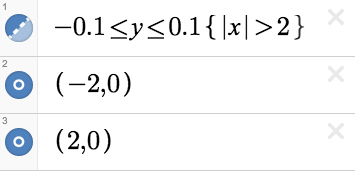
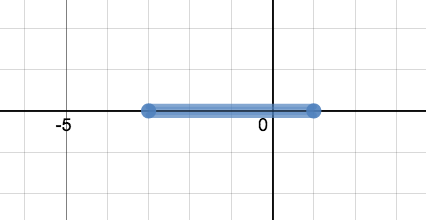
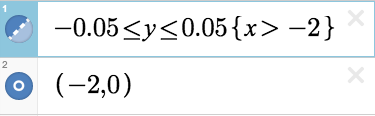
Here’s How

The best way to explain is to throw a few images in here and let them do the talking. Drop me a line on Twitter (@mjfenton) or in the comments if you have any questions (or tips for how to make this even easier or more awesome). Or if your name is Eli and you have a new feature to announce.

Graph 1

Screen Shot 2014-05-08 at 9.44.18 PM

Screen Shot 2014-05-08 at 9.43.53 PM

Graph 2

Screen Shot 2014-05-08 at 10.09.59 PM

Screen Shot 2014-05-08 at 9.46.14 PM

Graph 3

Screen Shot 2014-05-08 at 9.50.18 PM

Screen Shot 2014-05-08 at 9.47.19 PM

Graph 4


Screen Shot 2014-05-08 at 9.49.30 PM

Screen Shot 2014-05-08 at 9.47.47 PM

Desmos in my Pocket

A cool thing happened in Algebra 1 today. We’ve been working our way through an “Applications of Quadratics” unit (one that needs a healthy dose of revision in the near future). Today: projectile-motion problems.

The basic flow for each scenario:

  • Set the context (catapult, arrow, ball from roof, etc.)
  • Substitute an input, evaluate, explain the result in context
  • Substitute an output, solve, explain the result in the context

One student was struggling with the two-solution result to bullet #3 above. “How could there be two answers?”

I’ve been asked this question before, and feel like I’ve been able to help students reasonably well with a combination of questioning, hand-waving, sketching, etc.

But today? I reached into my pocket and added one more element to the conversation:

2014-04-24 22.15.01


Now, I love using Desmos on a laptop. Nothing beats that graphing experience in my mind. But to have a functional version of Desmos sitting in my pocket, ready to bring into a conversation at a moment’s notice… That’s cool.

Absolute Value Problem of the Month

Last summer I stumbled across the Problem of the Month corner of the Inside Mathematics website. I love the idea of a schoolwide problem with multiple levels of difficulty, since students of varying abilities at multiple grade levels can join in at the “low floor” of Level A and push themselves as far as they can toward the “high ceiling” of Level E. (If you’ve never seen the Level A to Level E progression, here’s a sample.)

My Problem of the Month/Week/Whatever

In the spirit of these problems, I’ve created my own sequence of Level A to Level E challenges involving absolute value.

Absolute Value (POM)

The sequence was originally inspired by a problem I saw in a student’s SAT review book. The SAT problem is more or less the same as Level D, and seems like an appropriate challenge for my Algebra 2 students. We’re about to begin our study of equations involving absolute value in my Algebra 1 class, so I wanted to adapt the problem (by “lowering the front of the of the ramp”) so it would be more accessible to that group of students. I also wanted to push the problem a bit further for my more advanced Algebra 2 students.

Here’s what I was thinking at each level.

Level A

Find one value of x for which |3x-17|>x

Before we worry about efficient methods for solving equations involving absolute value, I want my students to develop their reasoning abilities with equations (or in this case, inequalities) involving absolute value. The expression on the left is a type I’ve seen hundreds of times, but the inequality as a whole (in particular, the inclusion of a variable on the right side of the inequality) is a new twist for me as a teacher.

I anticipate some struggle here as students become familiar with the context, but once they realize what’s going on (and start plugging in various values of x to test them one at a time) I expect they’ll find success fairly quickly. In fact, if students start with integers (as I image they will) there are only four that will not satisfy the inequality.

Level B

Find one value of x for which |3x-17|<x

After I’ve baited them into the problem with an early dose of open-ended success, students will turn to a very similar problem with far fewer solutions. However, the method most students use to attack Levels A and B will likely be the same, so this second stage demands perseverance more than new methods.

Level C

Find four more values of x for which |3x-17|<x

If students have been thinking only in terms of integers, this third level will force them to break out of that. I anticipate comments along the lines of “This is impossible! I’ve already found all four solutions!” and I look forward to hearing the next part of that conversation in each group, as students wonder aloud (or ask me directly), “Are we allowed to use non-integers?” (To which I’ll reply: “Did I say you couldn’t?”)

Level D

Describe all the values of x for which |3x-17|<x

Now we’re pushing toward the idea of an interval, and possibly the use of more efficient techniques to solve for the endpoints. Students may have a head start here based on what they stumbled across in Level C.

Level E

Describe all the values of x for which |ax-b|<x

If any of my students race through Levels A-D, I want to have a challenge that may hold their attention for a bit longer. Maybe they learned something about the relationship between 3, 17, and the interval endpoints in Level D. This fifth challenge will push them to describe that relationship with clarity.

Disclaimer

I haven’t used this yet with my students, though I will very soon. And I’m not sure I’ll get the whole school on board this round with an untested problem. For all I know, this could be too easy, to difficult, too boring, or too something else. I’ll post an update after we’ve explored the problem. Feel free to drop a comment on the quality of the problem, or ideas for improving it (whether you use the problem with your students or not).

Credit To Desmos

With that disclaimer aside, I should mention that without Desmos I wouldn’t have created this sequence of absolute value inequality challenges. When I saw this problem I was feeling rather lazy. So instead of breaking out pencil and paper I just graphed the two expressions in Desmos:

Screen Shot 2013-10-09 at 6.36.26 AM

Problem solved! Any x-value between 4.25 and 8.5 will satisfy the original inequality (|3x-17|<x).

But then I wondered about changing the parameters. Time for sliders!

Click to be transported to a land of dynamic slider action!

Anyway, that’s how Level E was born. I still had to lower the ramp at the front of the problem, so that’s where Levels A-C came from.

I’d love to hear what you think. If you have anything to share, drop a line in the comments!