Charge! – Activity Makeover Series

Background. I’ll share an activity. Offer some ideas on what’s wrong. Invite you to share your own diagnosis/treatment. Then (end of week) share an upgraded version of the activity. (More details about this series are available here.)

Activity and Diagnosis

A couple years ago, I sat against the wall in my sons’ bedroom, taking screenshots of my smartphone once every four minutes for an entire evening. (Why, you ask? For math!)

The result: Charge! (quite likely my only decent entry into the world of three act tasks).

About a year ago, I created an Activity Builder version of the task. And I’ve never been satisfied with it.

I think it’s better than nothing at all, but undeniably worse than the slide-driven, conversation-rich, paper-and-pencil version I posted on my blog a while back.

When it comes to the Desmos activity building code, this activity—even in its AB-powered form—succeeds on several fronts, including “create problematic activities” and “connect representations” (among others).

However, it struggles in ways that overshadow its strengths. Most notably:

#5 – Give students opportunities to be right and wrong in different, interesting ways. The AB version of Charge! feels too scripted. Too narrow. Rather uninteresting. “Do this. Now this. Next, this. Now do this.” And so on, all the way through the activity. There’s really just one path, and the activity leads students along it with minimal opportunity (or even need) for careful reflection or critical thought.

#8 – Create objects that promote mathematical conversations between teachers and students. This is a tricky one. I believe the activity could generate classroom discussion, but that the sheer number of screens works against that possibility, rather than in support of it. Let’s assume a 50-minute class period, with 45-minutes dedicated to this activity. That’s just 2.5 minutes per screen, which isn’t terribly conducive to classroom discussions. It might be wise to trim the number of screens so that there’s room for deeper discussions on a smaller set of screens.

#13 – Ask proxy questions. Would I recommend this activity? Nope. Not in its current form. I’d be much more comfortable recommending the original slide-based version. With the activity parsed into 18 step-by-step style screens, there’s no one screen with anything really interesting happening on it. One of my colleagues likes to consider the quality of an activity by asking whether any of the work students do on a given screen could be considered fridge-worthy. In other words, if they could print it out and take it home to show mom and dad, would it end up on the fridge as a proud display of something deep or delightful? Again, because I’ve chopped the interesting work in Charge! into 18 tiny bits, the answer is no. Nothing fridge-worthy in this approach.

Invitation

  • Will you offer your own diagnosis? A second opinion of sorts? What do you think is wrong with this activity?
  • Better yet, will you offer suggestions for your own treatment? How would you make this activity better?
  • Better still, will you build and share a new, better activity that addresses the shortcomings identified in one of the diagnoses?

Drop a line (or two) in the comments, or let me know what you think on Twitter (@mjfenton).

I’ll be back Friday with a new treatment of my own.

Cheers!

Tesla Model 3

I’m fascinated by the pre-order hype surrounding Tesla’s latest car, the Model 3.

https://twitter.com/elonmusk/status/716510703000100865

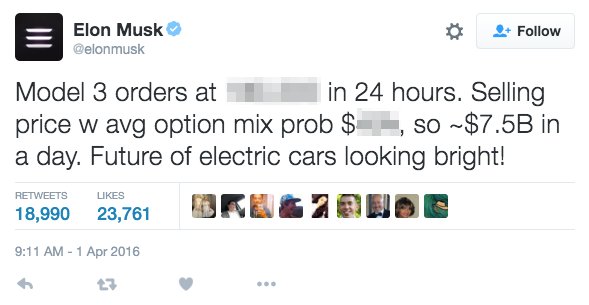
With a little help from Skitch, let’s turn this scenario into a math problem.

image1

Throw that image on the screen and ask students:

  • How many orders in 24 hours?
  • What info would help you figure that out?

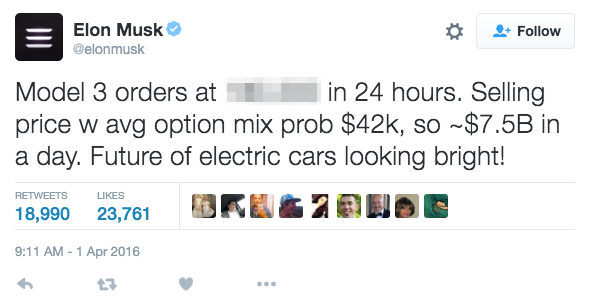
Ideally, after making some predictions (and writing them down!) students make a request for average price per vehicle, and you deliver:

image2


When they’re ready for the reveal…

https://twitter.com/elonmusk/status/715934657720639488

Sequel #1

Let’s see what else we can do with this…

https://twitter.com/elonmusk/status/715955186175459332

https://twitter.com/elonmusk/status/716089404985487361

https://twitter.com/elonmusk/status/716341849409998849

https://twitter.com/elonmusk/status/716693951260938241

Pre orders began on Thursday, March 31. Tesla promised a numbers update on Wednesday, April 6. How many pre orders do you think will have been placed by then?

  • Make a prediction.
  • Use math to find a more accurate answer.
  • Explain your thinking.

I’ll drop an update here once we know the answer.

Update!

https://twitter.com/elonmusk/status/718112326889529344

Sequel #2

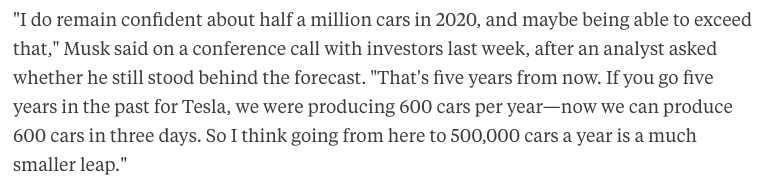
Tesla aims to sell 500,000 cars per year by 2020. Consider this comment from CEO Elon Musk:

image4

Based on the information in the comment above:

  • Do you think Tesla will meet its 2020 goal?
  • What sort of year-over-year percentage growth will this require?
  • If you think they’ll miss the mark… by how much?
  • If you think they’ll surpass the target… by how much?

Invitation

Drop an answer to one of the questions above in the comments below. Or, share another idea or two for how this Model 3 craze could play out in a math classroom.

Billion Dollar Bracket

This gets me every time. I suppose it goes without saying that I loved this, too.

I don’t know why, but there’s something about that noise (in a math problem, no less) that simultaneous makes me giggle and fires up the I-need-to-know-what-was-said corner of my brain.

So I made this:

Since I made the video ((For the record, that was two months ago. This post has been sitting in draft purgatory for long enough. So it’s time to drop this in the urgent bin and get it out the door.)) a few things have happened in the world of college basketball.

  • UCLA won
  • UCLA won
  • UCLA lost
  • I’m sorry, did they keep playing the rest of the games after UCLA lost?
  • Nobody won. The bracket challenge, I mean. I think someone won the tournament. I’m not really sure.
  • Warren Buffett and Quicken picked up about a billion new home loan leads.

At any rate, I’m not entirely satisfied with the result. I mean, I was really hopeful UCLA could make it to the Elite Eight I could turn this into an engaging lesson hook, but the first group I tried this on kind of just stared at the screen after the Act 1 video ended.

So I’d love some feedback, either in general, or in response to some of these:

  1. Is there any potential here? (I think there is…)
  2. What bits have I got right, if any?
  3. How would you hook students with the “what are the chances…” question here?
  4. Am I missing the point? Is there a better question to ask besides “what are the chances…”?

Thanks in advance for your thoughts!

P.S. If you’re interested in a link to Act 1 and Act 3, you’re welcome. And here’s a notebook full of some links and images I gathered but never used.