I created a silly little game for my Algebra 1 students several weeks ago. The motivation? Five-fold!
- We’re a little weak with graphing lines. Some open-ended, Desmos-driven, instant-feedback style practice may help.
- Domain and range? Yeah, not so much.
- Inequalities? Haven’t done them justice. Yet. (Growth mindset, baby!)
- Vertex form for quadratics? Still struggling.
- We tried Des-man a few days before this game and found nothing but pain and frustration. Some could be attributed to me (in particular, a bungled launch of the activity), some to students’ lingering struggles (noted above), and most of the rest to the declining state of our netbook cart. (But they seemed so cool in 2009!)
At any rate, to get that bad taste out of my mouth and set the stage for greater success on the next Des-man go around, I created the Dot Capture Game. Here’s what you need:
- Students (working in pairs)
- Devices (we actually used 50% smartphones, 25% tablets, 25% laptops)
- The world’s greatest, most beautiful graphing calculator
And of course, the handout:
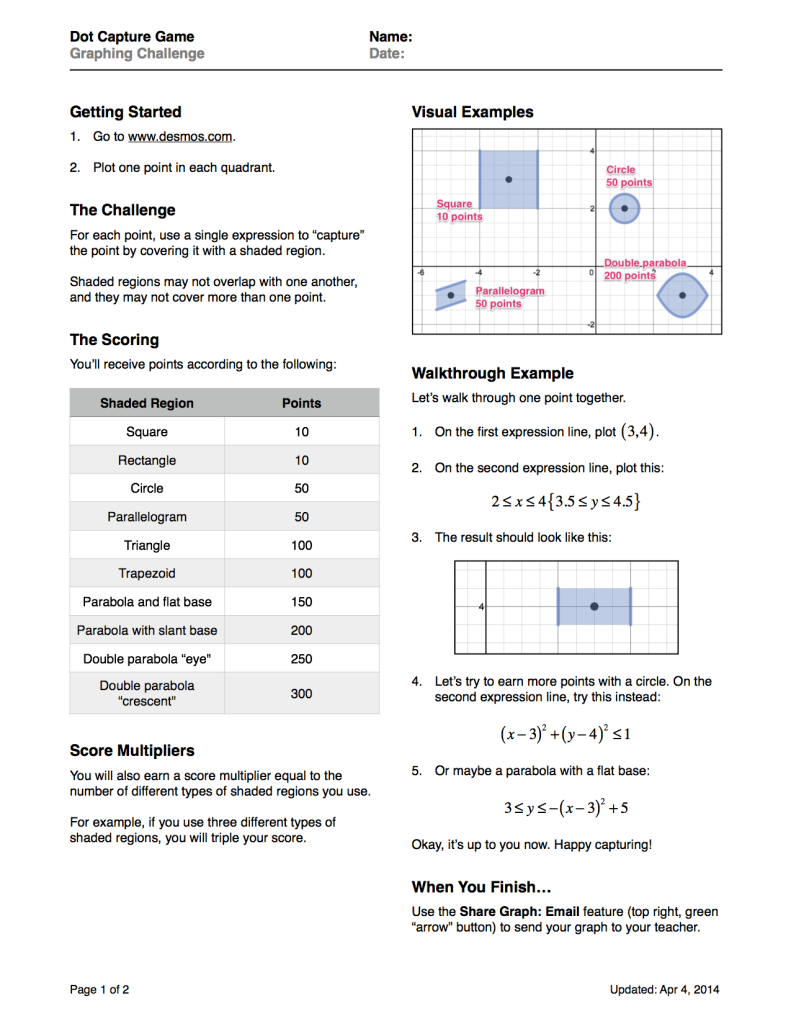
Getting Started
Give a brief intro—or none at all—and turn ’em loose. If your experience is anything like mine, you’ll find yourself the weaving in and out of some great (albeit trivially-inspired) conversations about slope, intercepts, point-slope form, domain, range, inequalities and shading, vertices, direction of opening, etc.
This is definitely not high-quality modeling stuff (it’s not even low-quality modeling stuff), but it proved a great way to engage students with meaningful (read: productive) practice on a variety of topics related to graphing.
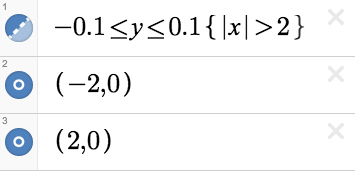
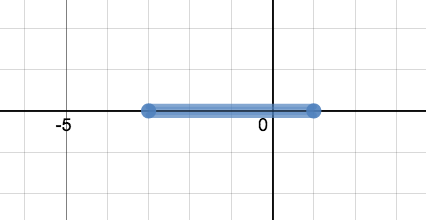
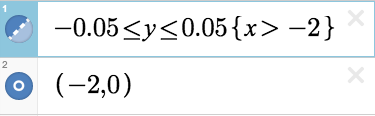
Oh, and the winner in my class? Here you go:

Final Thoughts
After trying this out in Algebra 1, I thought I’d throw it at my Algebra 2 and Precalculus students to see what they would do with it. It turned out to be good practice in those settings as well. Before sharing with these followup classes, a quick tweak to the handout was in order. In my first class, several students lost their graphs and expressions after hitting a deadly combination of keys on their device, and only one or two had been keeping a shiny written record. So to protect against future heartache, I added a second page to the handout. Here’s what one of them looked like at the end of class:

Update
Here’s a sweet suggestion from Desmos:
@mjfenton What if Ss rolled two dice to determine which curves they had to use and the numbers also represented the coordinate to capture?
— Desmos (@Desmos) May 22, 2014