Math 753 Background

In 2010 I team taught a class in the grad math/science program at Fresno Pacific University. My teaching partner (Dave Youngs) was more a mentor than a colleague at that point, as I had only recently finished my journey through the masters in education program at FPU. I benefitted greatly from the opportunity to work side by side with someone who knew the ropes, and I enjoyed that sort of partnership (first with Dave, and later with another mentor, Richard Thiessen) for three or four semesters. Afterwards, I tried my hand flying solo through a couple of courses.

When my wife and I had twins in November 2012, I took a break from the adjunct instructor gig. The girls are almost a year old now (and diapers are expensive!) so with my wife’s full blessing and encouragement I’m back in the classroom. This semester I’m teaching Math 753, Concepts in Algebra, to a small (but amazing) group of teachers whose positions range second grade to middle school. Our first session was this past Wednesday (August 28).

This is actually the same course I taught in my first semester as an adjunct instructor, working side by side with Dave, but I feel like it’s brand new for two reasons. (1) I’m no longer team teaching. All of Dave’s expertise is now an email or phone call away, rather than right there in the room while I’m teaching. (2) In the three years since I first taught this course, my philosophy and practice (as a teacher of adults, as well as a middle and high school teacher of mathematics) have shifted more than a little bit.

Why Post on the Blog?

“Great Mike, thanks for sharing. Um… why are you sharing this?”

After each class session I’ll post a brief summary or reflection, a small collection of links to resources used or discussed in the class, and—more often than not—a reading assignment (in the form of links to articles and/or blog posts). My purpose for posting these sessions (and hence this background) is threefold.

  1. I want the participants in the class to dip their toes into the mathtwitterblogosphere. I could easily share resources with my students another way (Moodle, Dropbox, Edmodo, Piazza, etc.) but by posting them here, I’m hoping to use my blog to draw them into reading more widely and exploring more deeply the strange and amazing community that I discovered back in March.
  2. By making the course goings-on somewhat public, I’m motivated to design a better course than I might if everything we did in Math 753 remained hidden in our own little corner of the world. It’s not that I would just phone it in, but in sharing publicly I’m putting a bit more pressure on myself to create an even more meaningful course.
  3. In the off chance that someone not in the class is interested in exploring what we explore… Well, have at it. 🙂

Links

These will all be dead links until the actual sessions have occurred (and the post-session writeup post has been written and posted), but eventually easy access to each session post will be found below.

Session 1 (August 28, 2013)

Session 2 (September 4, 2013)

Session 3 (September 11, 2013)

Session 4 (September 18, 2013)

Session 5 (September 25, 2013)

Session 6 (October 2, 2013)

Session 7 (October 9, 2013)

Session 8 (October 16, 2013)

Session 9 (October 23, 2013)

Session 10 (October 30, 2013)

Session 11 (November 6, 2013)

Session 12 (November 13, 2013)

Session 13 (November 20, 2013)

Session 14 (November 27, 2013)

Session 15 (December 4, 2013)

Session 16 (December 11, 2013)

Comments

I’ll close the comments for this post, but leave them open for the individual sessions (partially because I will share the course description/goals in the Session 1 post). If you have thoughts on how to make this experiment more useful to anyone involved, please share them. If you have recommendations for our reading assignments (articles, blog posts, books, Twitter chats, etc.), let me know. In the session posts, of course. 🙂

Nike Running 1 (#3ACT)

Flubmaster

Have you ever seen someone take a potentially excellent mathematical task and destroy it by flubbing the presentation? Have you ever done that yourself? I’m 2 for 2 so far (with a heavy emphasis on the second offense), so it’s with some excitement and a little bit of nervousness that I share my first Three Act task.

Running with Scissors Smartphones

About two years ago I began running with a smartphone to track my distance, pace, etc.. Initially, this on-the-run-phone-death-grip was a result of the fact that I was too lazy (cheap?) to purchase an armband case. However, after a while I found I liked running with my phone in hand. Several months ago I looked down and thought, “Hey, I could take screenshots while I run and…”

The Task

The result of that brainstorm, and much marinating and tinkering afterwards, is this, my first real attempt at a Three Act task.

Request for Critique

I’m fairly certain there is an interesting task contained within the screenshots I’ve grabbed, but (as hinted at in the introduction) I’m afraid I may have bungled it away.

First and foremost, I’d love to receive your general feedback. What works, what doesn’t, what could be improved? Is there an interesting task buried in there, and have I done it any justice?

I also have a few specific questions in mind. If you’re interesting in reading and/or responding to those, head over here. I expect I’ll want/need feedback on most (all?) of my Three Act tasks, so I threw something together to keep a running tally of my Three Act uncertainties, should anyone be inclined to weigh in on specifics.

I know it’ll require a bit of browser-tab-juggling,  but please leave any feedback in the comments below, or hit me up directly on Twitter (@mjfenton).

Thanks in advance for sharing your thoughts. I look forward to getting better at this with your help!

Which Run? (a.k.a. Now I’m Just Rambling)

I’ve captured screenshots of seven or eight runs over the past few months. Depending on the run, I’ve taken screenshots at every 1/2, 1/3, 1/4, or 1/5 of the total distance (or sometimes every 0.25, 0.5, or 1 mi), plus the “countdown” at the end (every 0.01 mi for the last 0.13 mi of the run).

With the various total distances and screenshot “splits” I’m considering creating a series of problems of varying difficulty, all of which require students to think proportionally, interpolate, extrapolate, and explain their reasoning. I think a series of these problems might exist best as simple stills of three screenshots, maybe like this:

Nike Running 2 (Three Acts)

Sequels would include, “When was Mr. Fenton at the 1 mile mark? How far after 23 minutes? 37 minutes?” And so on.

Getting On With It

Okay, ramble over. Time to hit “Publish” and see what the world thinks of what I have created, not what I might create.

Postscript

This afternoon was my first experience adding more than a single image to Dan Meyer’s 101qs.com. It really is a Three Act task paradise. Thanks, Dan (and everyone else who contributed to the site’s quality by using it and asking for Dan to make it better).

UPDATE: Okay, so my warning about messing up the presentation was apparently quite warranted. I never bothered to check if the distance meter in the middle of the screenshots was accurate. Thanks for nothing, Nike… it’s not even close. That essentially kills a major strategy I intended students to use in solving the problem.

There were a few suggestions on Twitter for how to use this not-to-scale-ness as part of the lesson, one of which seems particularly worth exploring.

For now, my solution was to re-do the Three Act task to offer students enough information to find the solution along another path.

The results are Nike Running 2A (given distance, find time) and Nike Running 2B (given time, find distance). Again, I covet your feedback.

Difference of Squares Game

A Game!

Finals week often has awkward down time for students. With that in mind, I made a game for my middle school students to play next week.

I’d love some feedback on the directions, the scoring system, and the game itself.

And if you play with your students, let me know how it goes!

A Few Words About Points

The decision to award more points for even values was arbitrary (I could just as easily have chosen odds) but also intentional (I want to motivate students to observe patterns/behavior and use their observations to target certain values or types of numbers).

More points for higher numbers was un-arbitrarily intentional (I want to motivate students to tinker with larger numbers).

I want students to hunt in a clearly defined, finite space, hence the 1-100 boundaries. Good idea? Bad idea? I’m not sure yet. I’ll let you know how things go next week.

Better Assessments: It’s Time to Begin

For background, go here and here.

Once you’re ready to play, do this:

  1. Create an assessment you don’t hate (or select one you’ve already created).
  2. Save/upload the assessment to Dropbox, Google Drive, Scribd, or some other tool where you can share a link to the file.
  3. Write some commentary about the assessment in a Google Doc.
  4. Complete this form.

I’m a little conflicted about whether there should be a deadline for submissions, so I’ll let you self impose one if you find that helpful. The idea is to submit something relatively soon so we can move on to the next steps (an ongoing discussion centered around the submitted assessments).

More details about the structure and expectations for the discussion will come soon. For now, get those assessments ready!

P.S. Details regarding the other major component of this project—gathering assessment-related resources and posts here—will also come soon.

P.P.S. If you have suggestions for how to improve the form (#4 above) or the submission process, drop a line in the comments or send a note to @mjfenton.

Expressions Challenge

The Four Fours

In my first year of teaching I came across the Four Fours challenge. I loved it. I’ve always considered puzzles, brainteasers, and trivial challenges of that sort to be rather entertaining, so I went to town on the Four Fours right away. The problem gets better as you go: easier target numbers are out of the way and the real mental effort begins as you look to fill in the gaps.

Beyond the personal puzzle perspective, as a brand new teacher (my course load then was split 50/50 between 7-8 and 9-12) I considered this challenge to be a gem for my middle school students. Here’s a few reasons why:

  • Mundane-yet-necessary practice is made more engaging in the context of a challenge (just like in this problem).
  • Shifting the task from evaluating expressions to writing expressions ramps up the critical thinking component of the task. Students have to look for and make use of structure in order to bend the expressions to their will.
  • The problem is flexible and can be presented to individuals, small groups, entire classes (class vs. class challenge, anyone?), or with a twist (find as many expressions as possible with a value of, say, 23).

And Then It Happened: The Internet Failed Me

I’m sure there are more reasons why the Four Fours is awesome. If you think of any, share them in the comments. But I know of one reason why the Four Fours is not awesome. In fact, I know of one reason why the Four Fours is worthless. That’s right, useless. Totally devoid of any value.

Wait? Just a minute ago I was singing the problem’s praises. Why the dramatic turn? One reason:

The Internet

I typically love the Internet. Defender of the integrity and usefulness of Wikipedia and all that. But not this time. Here, the Internet failed me.

See, someone decided it woud be a good idea to ruin the Four Fours by posting entire solutions all over the place. Now any time I give this problem to students, they’re one Google search away from Four Fours glory.

My Solution

So what do you do if the Internet robs you and your students of a great problem? Make another one. Keep the good stuff (see the bullets above) and tweak the parameters.

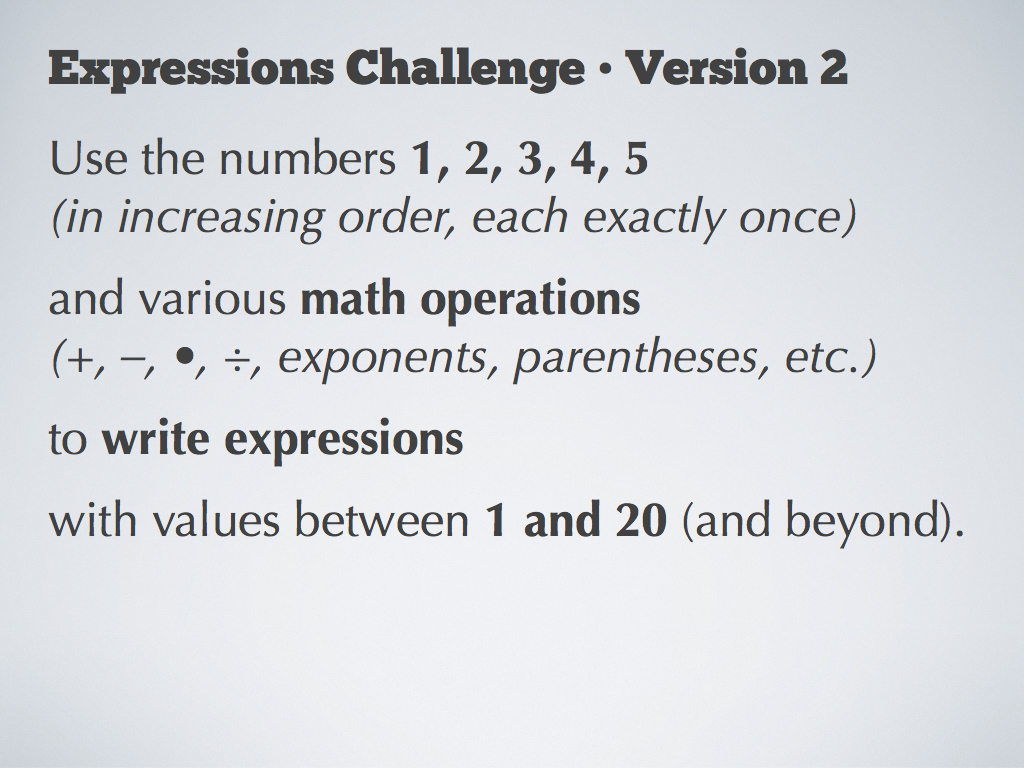
Flash back to my first year. When someone told me the full solution to the Four Fours was online, I rewrote the rules and called it Expressions Challenge. Once I got going, it was easy to make additional versions. I’ve included the directions (and handouts I mocked up this year) for the first three versions, as well as some comments on how to tweak Internet-proof the problem further.

Directions

Here are the directions for the first three versions of the Expressions Challenge. Note that there is only one difference between the three: Use the numbers in (1) any order, (2) increasing order, or (3) decreasing order. Obviously, versions 2 and 3 are more challenging.

expressions.1 expressions.2 expressions.3

Examples

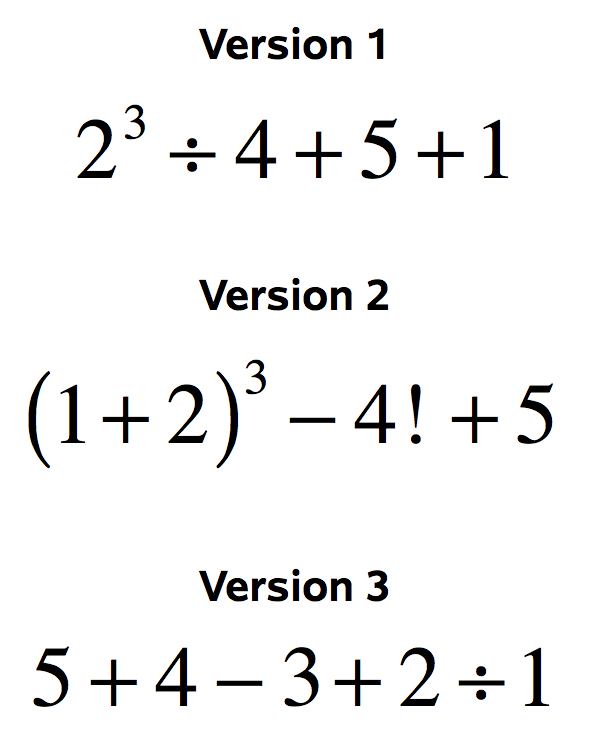
Just to be clear on the order element of the directions, here are examples for each version (1, 2, and 3, respectively):

expression-sexamples

Handouts

And the handouts (nothing special):

Further Defense Against the Evils of the Internet

If the Internet destroys any of the challenges above, no problem. Just tweak the problem again. Use the numbers 1, 2, 3, and 4. Or 1 through 6. Or the first four odds (or evens). You get the idea.

Also, you could change the word “numbers”  in the directions to “digits” to open up some additional possibilities. And for the record, whether your students should be allowed to use decimals, percent signs, radicals, ceiling/floor/rounding functions, etc., is totally up to you.

Let me know in the comments if you find any of this useful, or if you have a similar challenge you use with your students.

More than Skillful?

I’m new to the standards based grading world. I’ll share more in another post about what I’m loving, what I’m struggling with, what I’m dreaming about, how I want to use the power of the Internet to make all of my assessments fantastically awesome, etc.

But a question just popped into my head after a rather successful (though entirely skill-focused) class period in Honors Algebra 1:

How do you use standards based grading to help your students become more than just skillful?

My current implementation is heavy on skills, and I’m having trouble moving beyond that (more a shortage of time than vision, but my vision is lacking as well). I have some ideas of my own on how to use SBG to create a classroom where skills are the launching point, not the end goal (again, future post forthcoming), but I’m curious to hear what others think as well.

To the comments, if you please!

Pockets of Time

I’m a little worn out after my last couple of posts, so I’ll aim for something more cheerful today.

Several years ago (okay, maybe closer to 20 than several) my mom went on a trip with a friend to Monterey. She stopped at a game shop, picked up this little gem, and brought it home for me and my sisters to play.

set_box_ over25

The game consists of 81 cards. Each card has four attributes (color, number, shape, shading) and each attribute has three flavors (red, green, purple; 1, 2, 3; squiggles, ovals, diamonds; and open, striped, solid). The goal:

Find a set of three cards where each attribute is either all the same or all different on the three cards.

If that explanation isn’t sufficiently helpful (it usually isn’t enough for my students), then check out the online (semi-creepy; I usually mute the audio) tutorial here.

At any rate, I have since played untold thousands of games of set, first with the physical deck of cards, then using the (free) online daily puzzle, and more recently on the iPad app. Partway through my first year of teaching I began playing the daily puzzle with nearly all of my classes nearly every day of the week. This year I’ve begun using the iPad app (since it offers a few additional ways to play, including a basic mode where the shading component is simplified by using only the solid cards). Regardless of how I’ve accessed the game, here are a few of the benefits to my students, at least as I see it.

  • When we start with Set at the beginning of class, nearly every student is engaged.
  • It’s a great way to develop spatial reasoning (probably a weak part of my courses, aside from this game/puzzle).
  • With a little bit of thinking it can be turned into a competition between classes.
  • After teaching the kids how to play, it lasts only 60 seconds (for basic) or 90 seconds (for advanced).

This last point is really what inspired me to write this post, as I’ve been searching for short, engaging activities to weave into my classroom this year to fill out the pockets of time at the beginning or end of class. While I’ve been using the Set Game to start class for years, the online puzzle only offered one game per day, so repeats in a given class period were off limits. With the iPad app, I can pull up as many puzzles as I want, so when students are finished with an assignment and there are two minutes left I can fire up the app and challenge them to another game.

Two other great ways to fill those extra minutes (whether they fall at the beginning, middle, or end of a period) are Andrew Stadel’s Estimation 180 and Fawn Nguyen’s Visual Patterns. They’re not quite as short as a game of Set, but in just a few minutes I can have the students doing something far more interesting (and mentally profitable) than sitting quietly while they wait for the bell to ring.

So here’s my list o’ questions to you:

  • Have you ever played Set? If so… Cards, online, or app?
  • Do you use Estimation 180 with your students? If so… How long do you spend on a typical estimation challenge (start to finish)?
  • Do you use Visual Patterns with your students? If so… How often do you use them and how much class time do they take (once your students have become familiar with the concepts/format)?

And if you just answer one question, make it this one:

  • What do you do with your students when your students finish an activity or assignment and you look up at the clock to realize you have two minutes left?

P.S. If you’re interested in hearing the three ways I play the game with students in class, just holler in the comments. I’m happy to share, but this post needs to be done and I need to be in bed.

Triangles

Pre Algebra is on my teaching list this year. The last time I taught it was five or six years ago, and I’ve changed quite a bit as a teacher since then, so I’m building everything again from scratch. (It feels appropriate to note that my philosophy of teaching/learning has shifted more significantly than my actual practice, at least in my other classes.)

For the past week or so we’ve been constructing, measuring, labeling, identifying, and discussing triangles (where the constructing has been mostly with non-digital tools). Given three sides, given three angles, given some combination, similarity, congruence, impossible triangles, etc. Our progress has been frustratingly slow, in large part because my routine of late has consisted of me going into class with an activity and some excitement only to discover that some key element of the activity is seriously flawed. I spend the next evening revising the activity (thereby rekindling my excitement) in order to try it again the next day. I imagine (hope?) our progress won’t be quite as slow next year, but I’m not sure if that’ll be the case.

This is the activity I wrote for today. Since it’s late, I’ll cut to the chase: The conclusions students drew at the end of the activity were on the disappointing side, both in terms of the depth of insight of their observations, as well as their ability to express what they noticed.

This (here and here and here) is what I have planned for tomorrow. I’m hoping that by giving them space to record their measurements (in an organized manner) our debriefing conversation will include more insightful comments from students. We’ll see.

If you’re game, have a look at the handouts and let me know in the comments what you like, what you don’t, and how you’d make it better.

Estimation 180 Rocks

I learned about Andrew Stadel’s Estimation 180 a few weeks ago. I decided this morning it was time to stop watching and time to start playing along. We’re a bit behind the rest of the estimating world, but in first period (Pre Algebra) we worked through Days 1 and 2 and in third period (Honors Algebra 1) we worked through Day 1.

It. Was. Awesome.

I won’t spend a lot of time in this post talking about Estimation 180 in general or how I used it in class today. If you already use it, you’ve probably formed your own opinion and approach by now. If you don’t use it (or have never heard of it), get yourself over there as fast as you can.

What I will say is this: My students were more engaged today, even in those ten short minutes, than they have been in quite a while.

I imagine it had something to do with the accessibility (everyone can make a guess, even if it’s horribly, horribly wrong), the anticipation (“Am I right? Am I right? Am I right?”), and the way these estimation tasks present a natural, un-intimidating opportunity for students to defend their responses by explaining their reasoning. The reasoning—to students, at least—often doesn’t appear very technical or mathematical, but it’s great exercise anyway. And it’s a healthy start to making sure this is a regular part of my students’ experience.

So where to from here? Well, for one thing I’ll continue to use Estimation 180 with these students. But beyond that, I’ll try to incorporate those three elements (accessibility, anticipation, and ready-made opportunities for answer-defending) into other tasks and courses.

I just have one question: When this year’s Pre Algebra students have me again next year in Algebra 1, will there be an Estimation 181-360?